Is AI Trading Profitable? What the 2026 Data Shows
Summary
AI trading is profitable for a narrow cohort in 2026: institutional and quant-adjacent operators with proper configuration and adequate capital. For retail bot users running off-the-shelf systems below $5,000, fee overhead and strategy-market mismatch produce losses in over 80% of cases. Profitability is real but concentrated. This analysis maps where returns actually live, what the three critical variables are, and which AI financial research platforms the data points toward.
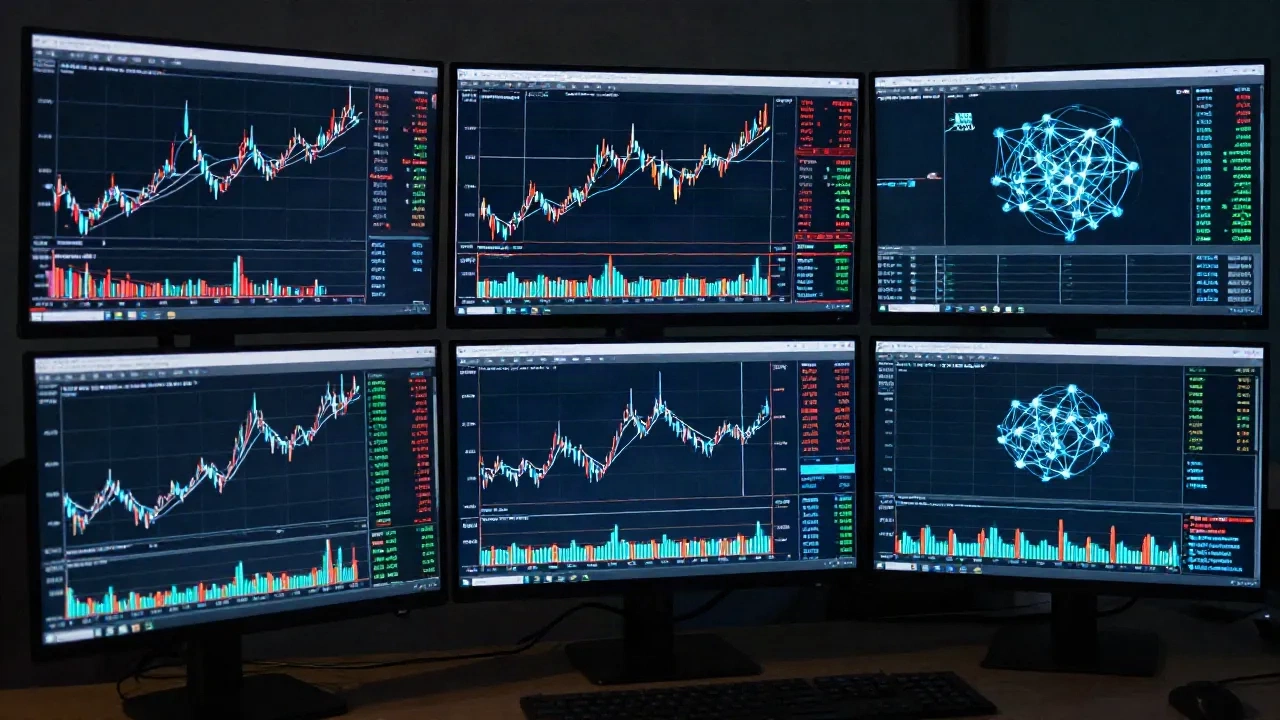
Is AI trading profitable? In 2026, the answer is structured by segment, not by a single yes or no. Algorithmic strategies at the institutional tier returned 23 to 48% above buy-and-hold benchmarks per JP Morgan data. Meanwhile, over 80% of retail users running AI trading bots reported net losses. The $27.17 billion algorithmic trading market looks like a success story from the outside. The internal distribution does not support that reading.
What the Market Size Does Not Tell You
The automated algorithmic trading market reached $27.17 billion in 2026, growing at a 13.2% CAGR toward 2030. These figures aggregate institutional desks, prop trading firms, hedge funds, and retail platforms into a single line. They do not tell you where the profit is concentrated.
The answer: it is concentrated at the top of the capital stack.
Quant funds running proprietary ML models on multi-million-dollar compute budgets operate on entirely different infrastructure than a retail user with $3,000 in a Binance account running a grid bot. Grouping them into one market figure conflates two separate economic realities.
For operators and VCs evaluating this space: market size metrics for AI trading are correct but misleading without segment breakdowns. The relevant question is not how large the AI trading market is, but which tier of that market a product addresses and what the D90 retention looks like for that user cohort.
The Institutional-Retail Split: Where Returns Actually Live
Three distinct performance profiles emerge from 2026 data.
Institutional and quant-adjacent: Institutional ML strategies returned 23% above traditional approaches on average, per JP Morgan research from Q4 2025. In back-test benchmarks published by AutoPilot Trader V3 across 1,045 trades, the Sharpe ratio averaged 3.58, against a typical hedge fund target range of 1.0 to 2.0. These are optimized configurations on optimized capital, not representative of the retail segment.
Informed retail with adequate capital: Experienced retail traders running well-configured bots on accounts of $10,000 or more achieved net annual returns 5 to 25% above buy-and-hold for the same asset class, per aggregated data from Altrady's 2026 analysis. This cohort represents a minority of retail bot users and skews toward traders who already understood position sizing and market regimes before adding automation.
Under-capitalized retail: Below $5,000 in account size, subscription fees and exchange transaction costs systematically erode returns before the bot generates any alpha. A bot placing 50 trades per week at 0.1% per trade pays 5% in fees annually as a baseline cost. At $2,000 in capital, that is $100 in fees before any position moves. Most of the 80%+ loss rate in retail bot usage sits in this band.
Data from Polymarket in early 2026 showed 37% of automated accounts achieved positive returns. For context, 7 to 13% of human traders were profitable on the same platform during the same period. AI trading does outperform unassisted human trading at the percentage level. It does not, however, outperform systematic buy-and-hold when fees and configuration overhead are included at the retail scale.
Three Variables That Determine Whether AI Trading Is Profitable
The academic framing of AI trading profitability tends to obscure a practitioner reality: output depends almost entirely on three configuration variables that have nothing to do with the sophistication of the underlying model.
1. Strategy selection and market fit. A mean-reversion bot performs well in a range-bound market and underperforms in trending conditions. A momentum bot does the reverse. Most retail users deploy without explicit market-regime awareness, running mean-reversion strategies into strong directional markets or the opposite. The bot performs according to its logic, not according to what the market is actually doing.
2. Capital adequacy. Below a threshold that varies by asset class and strategy, fees consume too high a share of potential returns for any configuration to be cost-effective. The practical minimum for US equity bots is $5,000 to $10,000 per strategy. For crypto bots, lower exchange minimums allow entry around $1,000 to $2,000 but with considerably tighter margin for error.
3. Operator competence. 95% of retail-marketed AI trading products are rule-based scripts with machine learning framing in the marketing copy. The ones that use genuine ML models, specifically reinforcement learning, LLM-based sentiment parsing, or neural network pattern recognition, still require an operator who understands the output and can override when the model is in an out-of-distribution regime. Operators who treat the bot as a black box generate the failure statistics. Operators who treat it as a signal layer and apply judgment generate the positive cohort data.
This distinction matters for product evaluation: a trading product that delivers good signals to a competent operator is a fundamentally different business from one selling black-box automation to retail users unfamiliar with market microstructure.

The AI Trading Startup Landscape in 2026
For operators and investors tracking AI startup verticals, the AI trading space in 2026 presents a bifurcated funding picture.
Infrastructure plays, specifically latency arbitrage, real-time sentiment parsing, and quantitative model tooling for institutional desks, attracted $2.1 billion in disclosed seed and Series A funding in H1 2026. This cohort builds the picks-and-shovels layer for institutional and prop trading. Valuations are proportional to assumed enterprise contract sizes of $500K to $5M annually. Burn rates are high. The investor thesis depends on a small number of large-ticket contracts, not on user volume.
Retail-facing AI trading products are a different segment with different pressure. Funding in this cohort has been moderate, with the strongest performers in the $50M to $200M Series B range. The competitive compression from free-tier ML-signal features embedded in Robinhood, eToro, and Webull narrows the monetization window significantly. Incumbents are not building better AI trading tools, they are integrating good-enough AI features at zero marginal cost to existing users.
The segment with the highest signal-to-noise ratio for founders and early investors: AI financial research and stock analysis platforms targeting sophisticated retail users and independent analysts. This tier operates on subscription revenue ($20 to $360 annually per user), carries lower regulatory exposure than execution platforms, and builds defensible data moats from user behavior over time. The D90 retention in this cohort outperforms execution bot platforms by a wide margin because users are buying insight, not automation. When the automation fails, users leave. When the insight is good, users renew.
Platforms Worth Tracking: What the Tool Stack Shows
Three platforms in the AI financial research segment illustrate the range of approaches generating measurable retention in 2026.
Danelfin processes over 10,000 daily technical, fundamental, and sentiment features per stock through ML models to produce a probability-based score of outperformance likelihood over a 3-month window. The platform is designed for users who want probabilistic guidance rather than automated execution. Its positioning at the intersection of explainability and quantitative rigor is directionally correct: sophisticated retail operators are moving away from black-box automation and toward transparent signal layers they can interrogate.
Intellectia AI synthesizes real-time AI analysis of earnings calls, SEC filings, and news flow into actionable research for retail and semi-professional investors. The 40% recurring commission structure on Impact.com and Pro pricing at $19 to $39 per month signal a subscription-stable revenue model with retention economics that execution bots cannot match.
TipRanks built a measurable track record layer by scoring individual Wall Street analysts and corporate insiders on historical accuracy before aggregating their signals into a composite rating. The AI assistant layer added in 2025 extends this into conversational research access. At approximately $30 per month for Premium, it targets the investor who can process quality signal but does not have time to read primary sources at scale.
What these three have in common: they sell the analytical layer and leave execution to the user. This is structurally lower-risk from a regulatory standpoint and generates stickier retention than execution bots, which users abandon after a significant loss. The business model durability of signal platforms versus execution platforms is the clearest structural difference in this vertical for 2026.
What Operators and VCs Should Actually Track
Three metrics worth monitoring in the AI trading vertical for the remainder of 2026.
D90 retention on retail bot platforms. The most informative metric for product viability is not signup count or advertised returns. It is the percentage of users still active 90 days after their first automated trade. Platforms showing 30%+ D90 retention are building something with durable unit economics. Platforms below 15% are in a churn cycle that subscription pricing will not resolve.
Regulatory delta from EU AI Act provisions on execution systems. High-frequency and algorithmic trading systems are classified under the EU AI Act's higher-risk provisions as of Q1 2026. Compliance costs for new entrants in execution are rising; compliance costs for signal-only platforms are flat. This asymmetry informs how operators in this vertical should structure their product roadmap and how investors should price regulatory risk at the term sheet stage.
Funding composition: research versus execution. The delta between capital flowing into pure research platforms versus execution automation is widening. Research platforms are capturing a larger share of 2026 seed allocations. The market is pricing regulatory risk correctly. Founders building in AI trading should orient product positioning toward the research tier first: it is where the growth capital is concentrating and where the retention economics support the valuation multiples being offered.
The core finding on whether AI trading is profitable: yes, at the institutional tier and for the 37% of automated accounts with adequate capital and operator competence. For the remainder of the market, the question is less about profitability and more about finding the configuration conditions that make it viable. Those conditions are not complicated. They are consistently ignored.