Best Stocks to Buy Now: 5 AI Infrastructure Picks for 2026
Summary
The best stocks to buy now in AI are concentrated in four infrastructure layers: GPU compute, custom silicon, advanced packaging, and high-bandwidth memory. This analysis covers five names -- Nvidia, Broadcom, TSMC, Micron, and AMD -- ranked not by price momentum but by their position at structural chokepoints in the AI stack. Each pick is grounded in capex disclosures, supply chain constraints, and leading indicators already visible in startup procurement patterns.

The best stocks to buy now are not distributed evenly across the market. In mid-2026, the highest-conviction opportunities are concentrated in the four layers that make AI compute physically possible: GPU silicon, custom ASICs, advanced semiconductor packaging, and high-bandwidth memory. This is a structural observation, not a momentum call. The five largest hyperscalers -- Microsoft, Amazon, Google, Meta, and Oracle -- committed a combined $320 billion in AI capital expenditure for 2026, up from approximately $204 billion in 2024. That capex delta maps to specific companies. The five names below sit at the chokepoints.
How AI Capex Flows Map to Stock Selection
The question operators and founders ask when reviewing public AI names is rarely about price targets. It is about chokepoints: which company sits at the most defensible position in the value chain, and how concentrated is its exposure to the AI infrastructure buildout?
In mid-2026, three structural chokepoints account for the majority of AI infrastructure value creation:
GPU compute: Nvidia's CUDA software ecosystem creates switching costs that are higher than the hardware cost itself. The 3,000-plus startups and enterprises running production workloads on CUDA do not switch lightly.
Custom silicon (ASICs): Broadcom and Marvell design custom chips for hyperscalers who want pricing leverage over Nvidia on training workloads. These contracts carry 18-to-24-month visibility -- unusual in semiconductors.
High-bandwidth memory (HBM): Micron, SK Hynix, and Samsung produce the memory that determines throughput ceilings on every AI chip sold. HBM availability, not GPU availability, is increasingly the binding constraint on cluster capacity.
Understanding these dependencies separates an operator reading supply chain signals from a retail investor following price momentum.
Nvidia (NVDA): The Infrastructure Standard With Visible Concentration Risk
Nvidia holds an estimated 80-85% share of the AI training chip market as of Q2 2026. Its competitive advantage is primarily the CUDA software stack, not the hardware itself. Three years of startup engineering built on top of CUDA creates switching costs that hardware price differences alone cannot overcome.
The data center revenue run rate sits at approximately $115 billion annualized based on Q1 FY2027 results. The Blackwell architecture is absorbing backlogged demand; H200 and B200 cluster lead times remain in the 4-to-6-month range as of August 2026.
The quantified risk: Microsoft, Meta, Google, and Amazon account for an estimated 45% of Nvidia's data center revenue. If hyperscaler CapEx cycles contract -- a scenario Goldman Sachs modeled as non-trivial for 2027 -- the delta would appear in Nvidia's quarterly guidance before showing in the stock price. Operators watching hyperscaler hiring freezes or datacenter lease cancellations have a 1-to-2 quarter lead on that signal.
Broadcom (AVGO): The ASIC Contract Visibility Story
Broadcom's AI semiconductor revenue grew 220% year-over-year in Q2 2026. The structural driver is hyperscaler diversification: Google, and at least two undisclosed additional hyperscalers, are commissioning custom ASICs from Broadcom to reduce dependence on Nvidia's pricing power on training runs.
The Google relationship alone is material. Broadcom designs Google's Trillium TPU (sixth-generation), the chip handling the majority of Google's internal AI inference workloads. Google's internal compute is estimated at over 200,000 TPU-equivalent accelerators deployed as of mid-2026, with annual refresh cycles.
Broadcom trades at approximately 27x forward earnings as of August 2026 -- a premium to the broader market but below Nvidia's 33x multiple, with stronger revenue predictability given multi-year ASIC contracts. The key monitoring signal: Broadcom's quarterly earnings calls consistently reference a pipeline of new hyperscaler ASIC engagements. Counting disclosed programs (currently three) and watching for the fourth announcement is a leading indicator for the next revenue step-up.
Taiwan Semiconductor (TSM): The Foundry No One Can Replicate This Decade
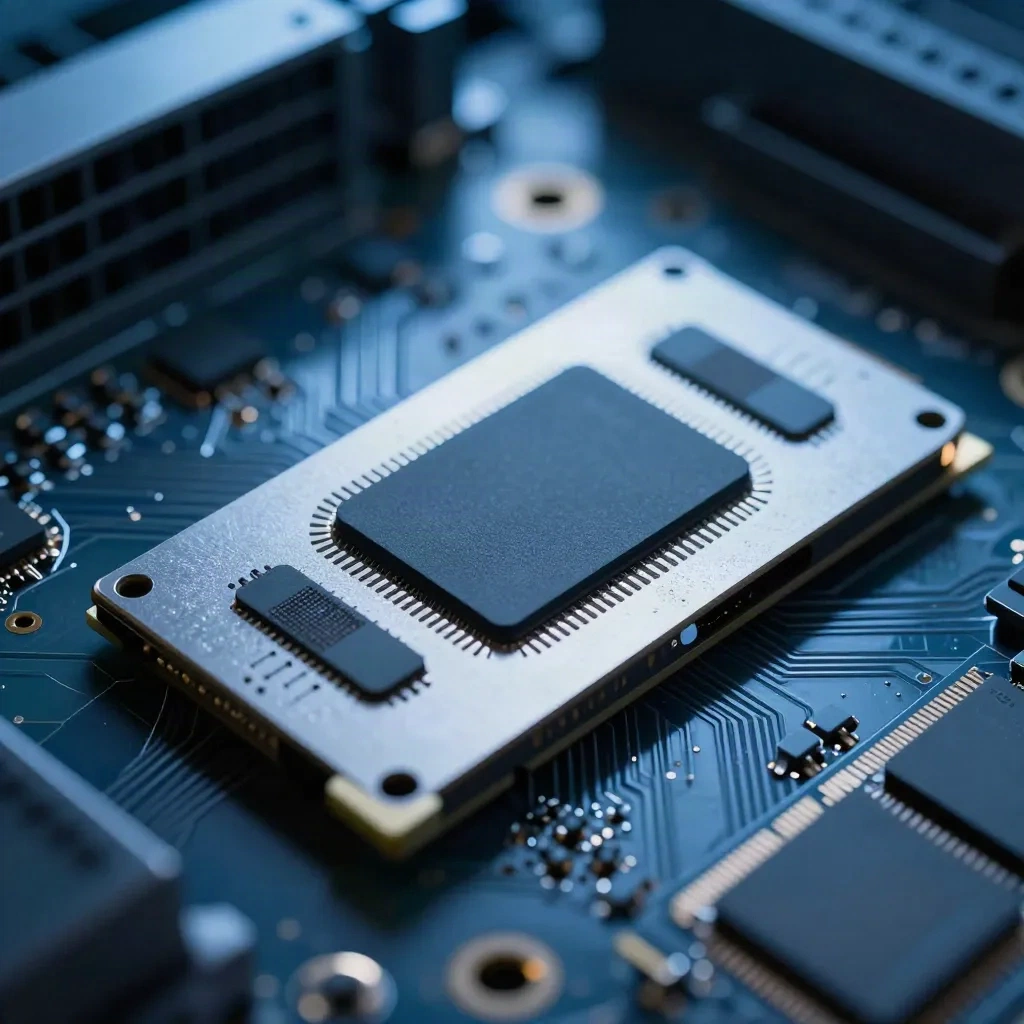
Every leading-edge AI chip -- Nvidia Blackwell, AMD MI300X, Apple M-series, Google Trillium, Broadcom custom ASICs -- runs through TSMC's 3nm or 2nm process nodes. TSMC does not compete with its customers. That structural posture is the moat no amount of capital spending by Intel or Samsung has closed in twenty years.
Key data points for 2026: TSMC's AI-related revenue grew to represent approximately 28% of total wafer revenue in Q1 2026, up from 11% in Q1 2024. CoWoS advanced packaging capacity -- required for integrating HBM3e with GPU dies -- is booked through Q1 2027. Each CoWoS-packaged chip generates 2-to-3x the revenue per wafer of a standard chip.
The persistent risk is geopolitical concentration. Taiwan fabrication accounts for over 95% of TSMC's advanced node capacity. The Arizona Fab 21 is in production but represents less than 5% of total advanced capacity. The Japan Fab (熊本 / Kumamoto, N7/N16 nodes) is in ramping production as of 2026 but does not address leading-edge AI chip demand. Institutional investors price geopolitical risk inconsistently, creating episodic entry points when Taiwan-related headlines move the stock.
Micron (MU): Memory Pricing as an AI Throughput Proxy
High-bandwidth memory is the bottleneck determining how fast an AI cluster processes data. Nvidia's H100 uses 80GB of HBM2e; the H200 uses 141GB of HBM3e; the B200 uses 192GB. Memory capacity per chip increased 2.4x across two product generations. Micron supplies a meaningful share of that demand alongside SK Hynix.
The financial signal: Micron's data center revenue reached $8.1 billion in Q2 FY2026, a 75% year-over-year increase. HBM average selling price is approximately 5-to-6x that of standard DRAM, making each unit of capacity shift toward HBM structurally accretive to gross margins.
Micron trades at approximately 14x forward earnings as of August 2026 -- the cheapest name on this list by that metric. The valuation gap reflects memory's cyclical history: DRAM prices collapsed in 2022-2023, creating persistent skepticism among generalist investors. The AI-specific counter-argument: HBM supply is structurally constrained through 2027 because HBM manufacturing uses different production steps from standard DRAM, limiting capacity conversion. Micron's HBM capacity is already contracted for 2026-2027.
AMD (AMD): The Inference Scaling Optionality Play
AMD does not need to displace Nvidia to generate returns. It needs to capture a fraction of the large and growing inference market, where CUDA lock-in is less severe than in research training environments and where cost-per-token matters more to buyers than ecosystem familiarity. The inference market is structurally different from training: workloads run continuously in production, operators optimize for throughput-per-dollar over absolute performance, and multi-vendor procurement reduces switching friction.
The MI300X accelerator is deployed at scale by Microsoft Azure, Meta, and Oracle for specific inference workloads. AMD's data center GPU revenue run rate is approximately $7-8 billion annualized as of mid-2026, roughly 7% of Nvidia's comparable figure -- but growing from a base near zero in 2023.
The forward signal: AI inference volume is growing faster than training volume as more models reach production deployment. That structural shift favors price-competitive alternatives to Nvidia on inference-only clusters. AMD's current valuation at approximately 22x forward earnings prices in moderate share gains but does not require AMD to challenge Nvidia's training market leadership.

Reading Supply Chain Signals Before They Appear in Earnings
The operational advantage for founders and operators tracking AI startups is access to leading indicators that precede quarterly earnings by one to three months.
Specific patterns worth monitoring:
TSMC CoWoS capacity announcements: Advanced packaging bookings are a forward indicator for Nvidia and Broadcom GPU volume. When TSMC announces CoWoS expansion, it signals GPU shipment growth 2-3 quarters out.
Hyperscaler CapEx disclosures: AWS, Azure, and Google Cloud guidance in quarterly earnings calls moves Nvidia, Broadcom, and Micron valuations within hours. The signal-to-noise ratio on these calls is high -- capital expenditure numbers are hard to revise mid-quarter.
Startup compute procurement announcements: When Series A and B AI startups announce Nvidia cluster access or significant compute contracts, that demand is absorbed into Nvidia's backlog 2-3 quarters later. Monitoring startup funding press releases and ProductHunt launches that reference model deployment gives a proxy for downstream GPU demand.
HBM allocation timing: Micron, SK Hynix, and Samsung disclose HBM allocation percentages on earnings calls. If HBM allocation to AI customers rises above 80%, standard DRAM pricing typically softens -- a sector-wide signal, not just a Micron story.
What This Framework Excludes and Why
Microsoft, Amazon, and Alphabet are frequently cited as the best stocks to buy in AI. Each company benefits materially from AI deployment. The reason they are absent from this list is dilution: AI revenue represents approximately 18% of Microsoft's total revenue, a smaller share of Amazon's, and an even smaller share of Alphabet's. The signal is buried in diversified businesses.
For operators building positions in public AI infrastructure, the question is not which large-cap technology company is safest. It is which company's revenue trajectory most directly reflects the AI infrastructure deployment patterns already visible in startup databases, hyperscaler procurement filings, and semiconductor supply chain disclosures.
Nvidia at approximately 85% AI revenue concentration is a purer expression of the thesis than Microsoft at 18%. The same logic explains why TSMC is on this list and Intel is not: Intel's foundry business is real but currently accounts for less than 3% of advanced AI chip manufacturing volume. The delta counts more than the strategic ambition.
The five names above -- Nvidia, Broadcom, TSMC, Micron, AMD -- sit at the chokepoints. The signals are measurable. Monitor the leading indicators listed above, not the price action.