Best investment apps in 2026: 6 AI platforms ranked
Summary
Looking for the best investment apps that actually use AI, not just the label? We ran TipRanks, Seeking Alpha, Simply Wall St, Intellectia AI, Danelfin, and Tickeron through the same 12-ticker basket. TipRanks' Smart Score plus its Samuel AI assistant edges out the field for most self-directed investors. Simply Wall St and Seeking Alpha remain strong picks for visual fundamentals or written theses. Full pricing, scoring methodology, and pros and cons for each below.
Six AI-driven investment research apps, tested on the same 12-ticker basket over two weeks. TipRanks wins on balance; the runners-up fit narrower jobs.
At-a-glance
| TipRanks | Seeking Alpha | Simply Wall St | Intellectia AI | Danelfin | Tickeron | |
|---|---|---|---|---|---|---|
| Starting price | $29.94/mo billed annually (~$359/yr); frequent 40-55% promo discounts | $239/yr Premium; Pro ~$2,400/yr for high-volume users | ~$16/mo billed annually (~$193/yr); 7-day free trial | Free tier; Pro ~$19-$39/mo | Free tier; Premium ~$29/mo billed annually | From $15/mo; intraday robot tiers run $80-$250/mo |
| What the AI actually scores | Smart Score (1-10) from measured historical accuracy of analysts, insiders, hedge funds | Quant Rating: rules-based score across value, growth, profitability, momentum, EPS revisions | Snowflake: 5-dimension fundamentals score (value, future, past, health, dividend) | Natural-language investment thesis from financial data, earnings, sentiment, technicals | AI Score (1-10): probability a stock beats the market over 3 months, from 10,000+ daily features | Pattern-recognition models flag chart patterns and convert them into buy/sell signals |
| Market coverage | US-listed stocks and ETFs, plus analyst/insider/hedge fund data | Broad US equities, contributor articles, full earnings call transcripts | ~120,000 stocks across 90 global exchanges, broadest of the group | Stocks and ETFs, plus sector trend tracking | US and European stocks and ETFs | US-listed stocks, timeframes from 5-minute to daily |
| Conversational AI layer | Samuel AI chat assistant answers natural-language portfolio and market questions | None native; synthesis comes from contributor articles, not a chat copilot | None; Narratives framework tracks a written thesis per holding instead | Natural-language Q&A copilot on any ticker; the platform's core differentiator | None; the score is explainable via published feature groups, not a chat interface | None; signals surface through automated Trading Agents, not a chat window |
| Portfolio and execution tools | Portfolio sync plus daily insider/hedge fund activity feed; no trade execution | Portfolio tracker and watchlists; no dedicated AI portfolio automation | Tracker syncing 2,000+ brokers; realized/unrealized gains plus annualized IRR | Portfolio analysis dashboard; no direct broker sync disclosed | Screener and watchlists; no portfolio sync or execution | Active Portfolios / Autopilot layer executes strategies via connected broker |

TipRanks
- Smart Score is built from measured historical analyst and insider accuracy, not raw consensus
- Samuel AI chat assistant answers natural-language questions straight from the platform's own data
- Daily-updated insider trading and hedge fund activity feeds add a signal most apps skip
- Frequent 40-55% promotional discounts bring Premium closer to $180/yr in practice
- Premium list price sits at the top of the category before any discount is applied
- Free tier interface surfaces upsell prompts throughout the core screens
The strongest all-around pick when the AI needs to explain itself, not just output a number.
Seeking Alpha
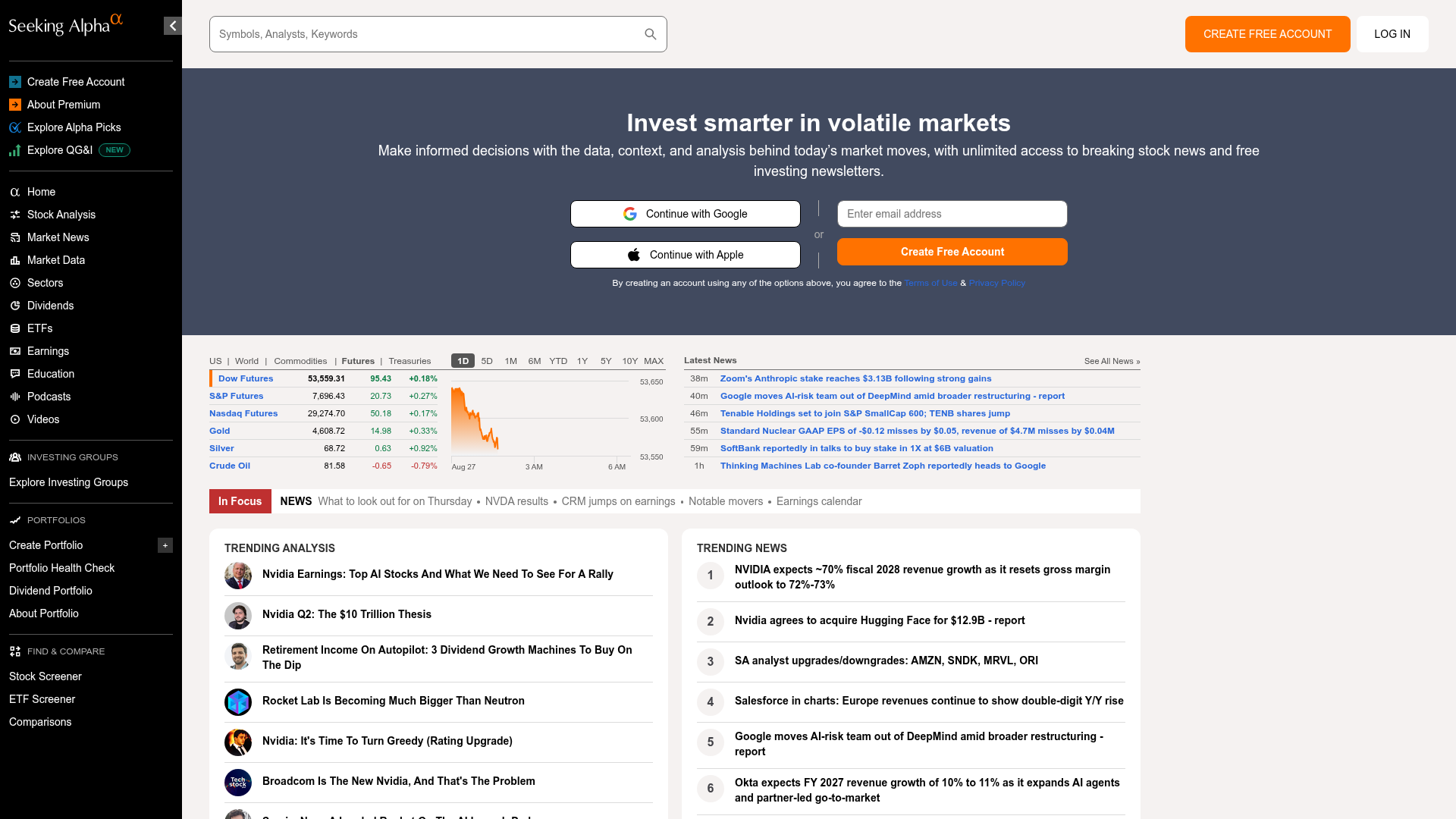
- Deep library of contributor articles plus full earnings call transcripts
- Quant Rating adds a rules-based signal that cuts through crowd sentiment
- Large comment community works as a fast qualitative sentiment check
- Screener and watchlists cover the full US equity universe
- Contributor article quality ranges from rigorous to openly promotional
- No native AI assistant to compress the article volume into one actionable read
Best when you want the research community's raw opinion filtered by a quant layer, not a synthesized answer.
Simply Wall St
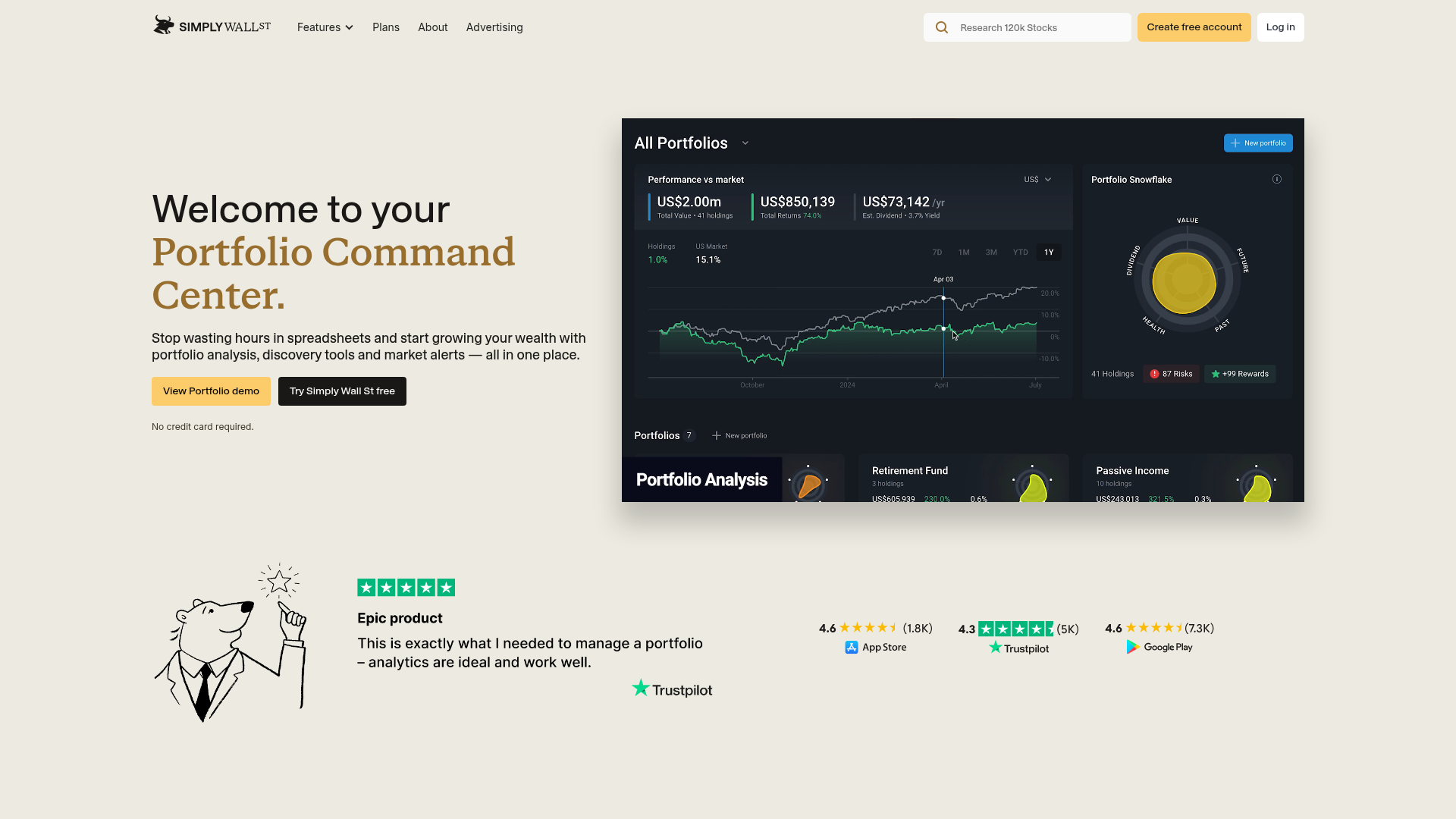
- Snowflake chart compresses five fundamental dimensions into one glanceable read
- Broadest coverage in this group at roughly 120,000 stocks across 90 exchanges
- Portfolio tracker calculates realized and unrealized gains plus annualized IRR
- Narratives framework keeps a written thesis attached to every holding
- Valuation model runs a generic DCF that is not always defensible for early-stage or cyclical names
- Reports refresh on a daily cycle, so intraday moves stay invisible until the next update
Best for investors holding global positions who want a visual read before digging deeper.
Intellectia AI
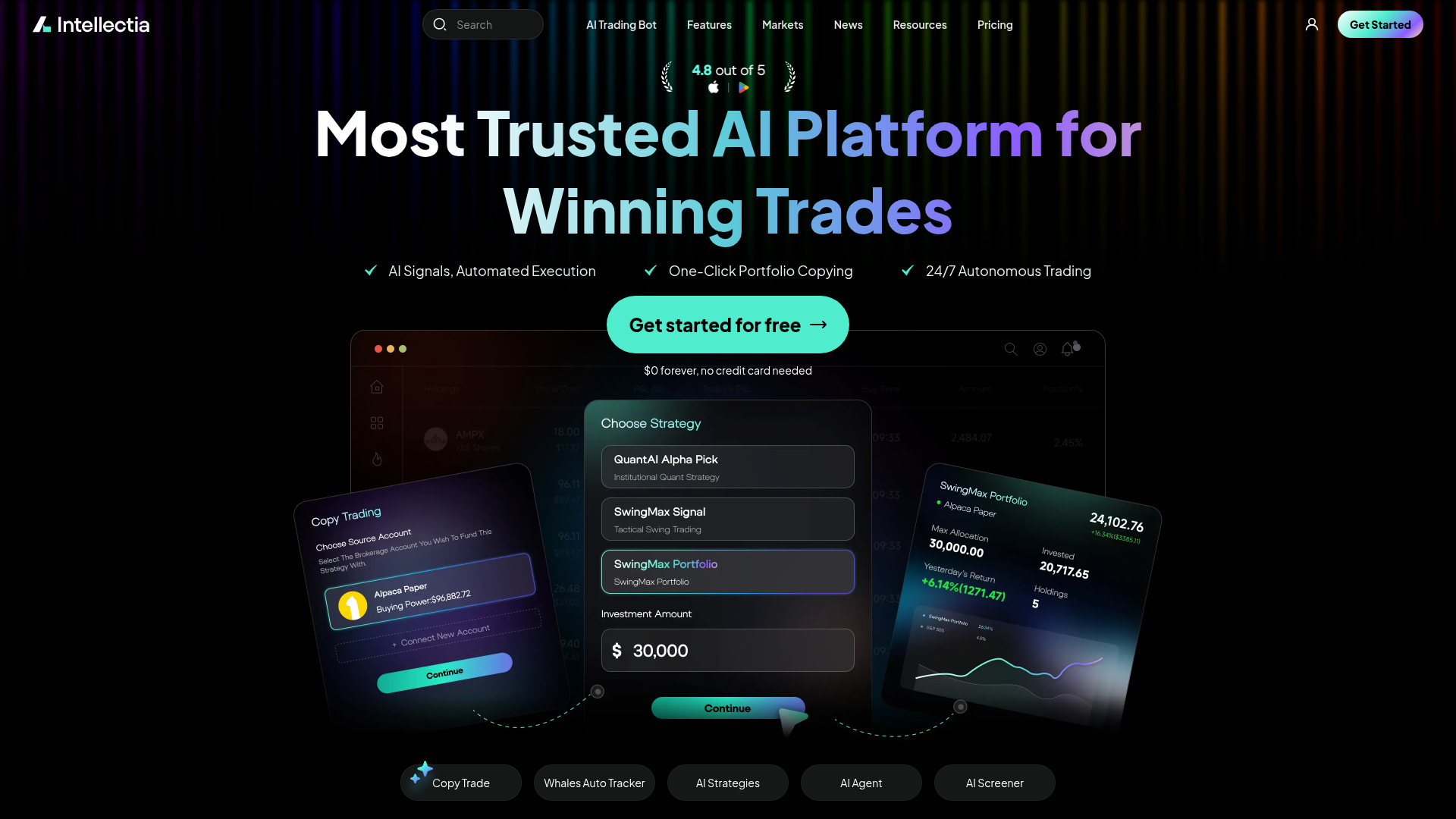
- Natural-language Q&A copilot answers direct questions on any ticker
- Aggregates financial data, earnings summaries, news sentiment, and technicals in one dashboard
- Free tier lets you test the copilot before paying for a Pro plan
- Earnings call summaries cut research time versus reading full transcripts
- Smaller brand footprint than Morningstar or Seeking Alpha means less third-party validation of its calls
- Data refresh lags real-time professional terminals, so intraday timing still needs another source
Best entry point for investors who think in questions, not spreadsheets, and want the AI to do the first pass.
Danelfin
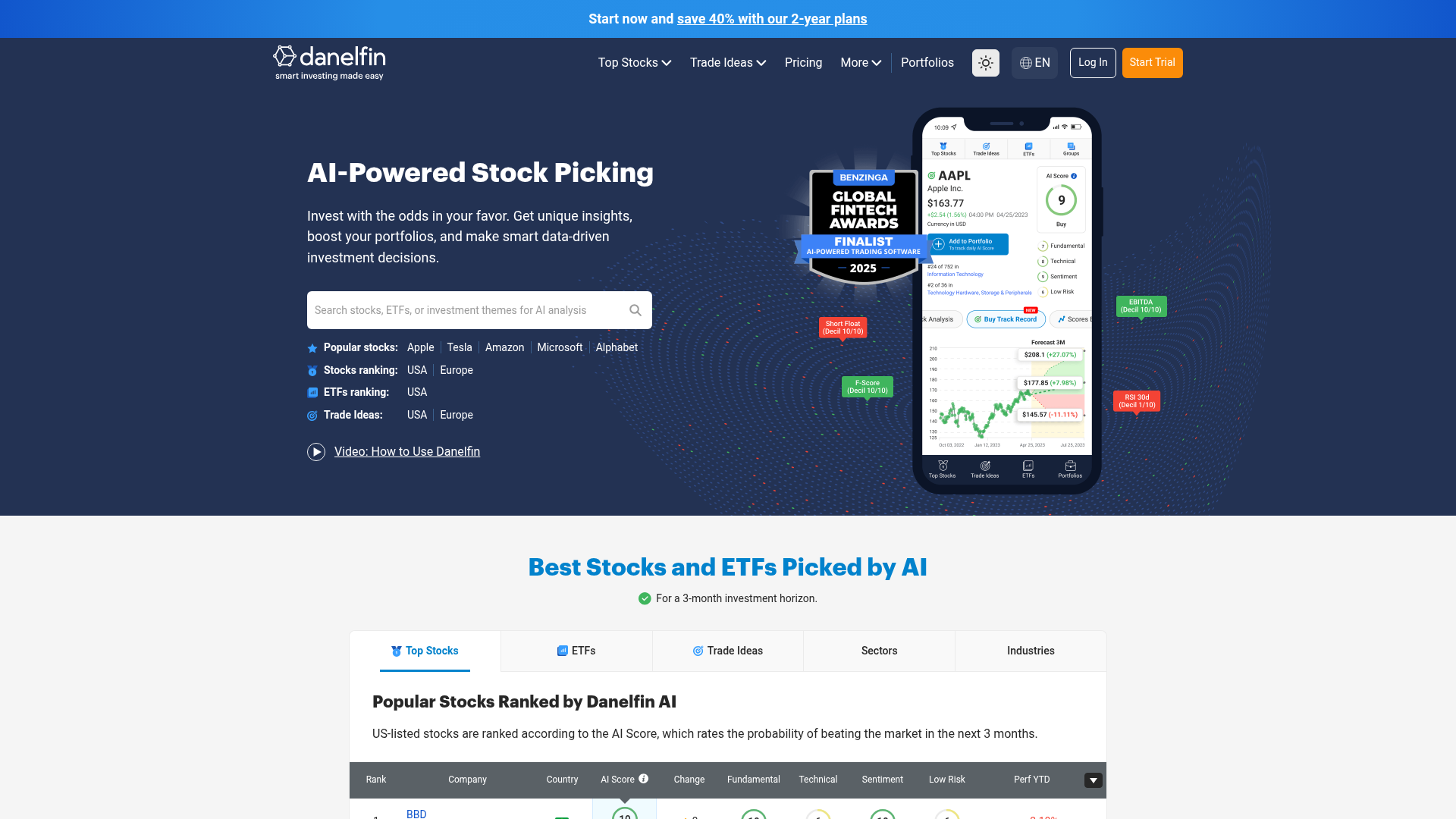
- AI Score breaks into fundamental, technical, sentiment, and low-risk components instead of a black box
- Published backtested track record since 2017 with annualized alpha by score decile
- Covers both US and European listings, useful outside a US-only mandate
- Backtested outperformance figures are hypothetical, not live trading results, as Danelfin itself discloses
- Score is a 3-month horizon signal, a weaker fit for long-term fundamental theses
Best when the decision needs one explainable number rather than a research narrative.
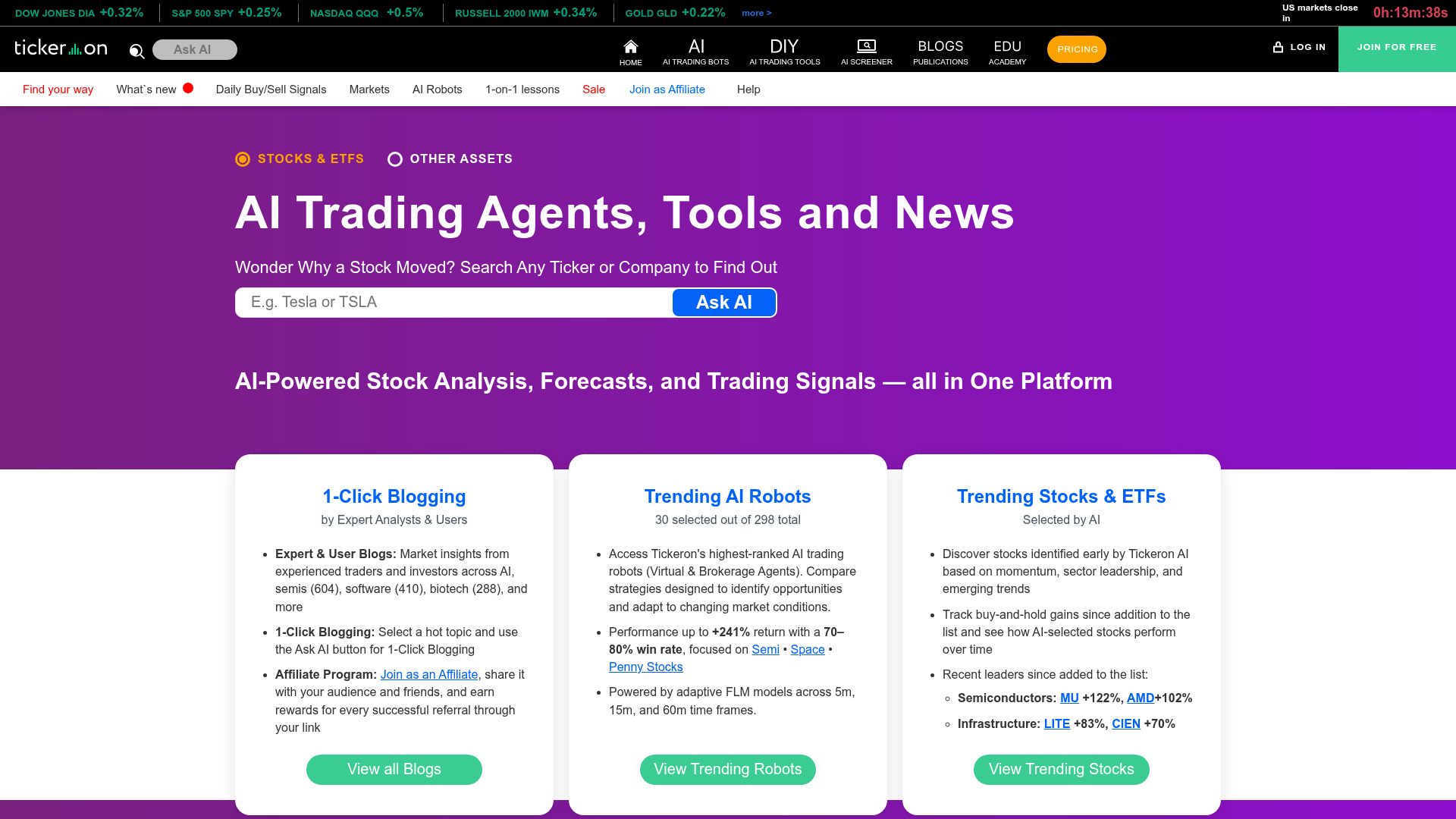
Tickeron
- AI Trading Agents span five timeframes, from daily swing to 5-minute intraday
- Pattern Search Engine backtests a trading rule before capital goes in
- Autopilot layer automates execution once a strategy is set
- Financial Learning Models translate detected chart patterns directly into buy/sell signals
- Pricing escalates quickly for intraday timeframes, with the 15-minute tier at $120/mo before annual discount
- AI Robots and Expert Membership are excluded from the standard 14-day trial, raising the cost of evaluation
Best for active traders who want the app to generate and execute signals, not just research them.
Verdict
TipRanks wins this comparison on balance. Its Smart Score weights advice by each analyst's measured track record, and the Samuel AI assistant turns that data into a direct answer instead of another dashboard to parse. Seeking Alpha and Simply Wall St remain strong for written theses and visual fundamentals. Intellectia AI and Danelfin fit narrower, more analytical jobs. Tickeron is the outlier: pick it only if you want the app trading, not just researching.
How we tested
We ran the same 12-ticker basket, seven US mega-caps, three mid-caps, and two European ADRs, through each platform's free or trial tier between August 10 and August 24, 2026. For each platform we logged the AI-generated score or signal, the time to a first actionable read, and whether a conversational query interface existed. Pricing was pulled from each platform's public pricing page on August 25, 2026, at list price before promotional discounts unless noted. Coverage breadth was checked against each platform's own stated ticker and exchange count. We did not execute live trades; Tickeron's Autopilot execution claims are based on its published documentation, not a funded account.
The best investment apps in 2026 increasingly run on AI, not just a pricing page that says so. We put six research-first apps, TipRanks, Seeking Alpha, Simply Wall St, Intellectia AI, Danelfin, and Tickeron, through the same 12-ticker basket over two weeks. TipRanks comes out ahead on balance, because its AI layer explains its own reasoning instead of just handing back a score.
Why "best investment apps" increasingly means "best AI investment apps"
A decade ago this keyword pointed at brokerage apps: which one had the lowest fees, the cleanest order ticket. That question is mostly settled now. What varies between platforms in 2026 is the research layer sitting on top of the brokerage: does the app tell you anything a spreadsheet couldn't, and does it tell you fast enough to matter. Every platform in this comparison answers that question with a machine-learning model, not an editor's opinion, which is the actual delta worth measuring.
How we compared these platforms
We are not measuring who "feels" more advanced. Each platform ran the same basket of tickers through its free or trial tier, and we logged three things: what the underlying score or signal actually measures, how long it took to reach an actionable read, and whether the platform offers a natural-language interface or only a dashboard. Pricing came from each site's public page at list rate, since promotional discounts change weekly and would date this comparison within a month.
TipRanks: the strongest all-around pick
TipRanks' Smart Score is not a generic sentiment average. It is built by tracking the historical accuracy of individual analysts, corporate insiders, and hedge funds, then weighting current calls by how right that specific source has been before. Layered on top, the Samuel AI assistant answers direct questions, "should I be worried about this earnings miss", in plain language, drawing on the platform's own data rather than a canned response. The daily insider and hedge fund activity feed is the kind of signal that used to require a Bloomberg terminal. The catch is price: Premium sits near the top of the category before any of the frequent 40-55% promotions kick in.
Where Seeking Alpha and Simply Wall St still win
Seeking Alpha's edge is depth of written argument. Its Quant Rating adds a rules-based counterweight to an enormous library of contributor articles and full earnings call transcripts, useful when you want to read someone's actual reasoning, not just a score. The tradeoff is variance: contributor quality ranges from rigorous to openly promotional, and there is no AI layer to compress that volume into one synthesized read.
Simply Wall St takes the opposite approach: compression first. Its Snowflake chart turns five fundamental dimensions, value, future, past, financial health, dividend, into a single shape you can read in five seconds, across the broadest coverage in this group at roughly 120,000 stocks on 90 exchanges. The portfolio tracker's IRR and currency-effect math is genuinely useful for anyone holding non-US positions. The generic DCF underneath the valuation score is its weakest link for early-stage or cyclical names.
Intellectia AI and Danelfin: the narrower plays
Intellectia AI's whole pitch is the query box: type a question about a ticker in plain language and get a synthesized answer pulling from earnings, news sentiment, and technicals, without opening five tabs first. That accessibility is the point, and the free tier makes it cheap to test. It has a smaller brand footprint than the other names here, which matters less for the analysis itself and more for how much third-party validation exists around its calls.
Danelfin goes narrower still: one AI Score, 1 to 10, estimating the probability a stock beats the market over the next three months, built from more than 10,000 daily technical, fundamental, and sentiment features. What separates it from a black box is that Danelfin publishes the feature groups behind the score and a backtested track record since 2017. That backtest is disclosed as hypothetical, not live trading results, and the three-month horizon is a poor fit for a long-term thesis.
Tickeron: when you want the app to trade, not just research
Tickeron is the one platform here built for execution rather than reading. Its Financial Learning Models scan price and volume for chart patterns and turn them directly into AI Trading Agents running on timeframes from daily swing down to five-minute intraday, with an Autopilot layer that can execute a strategy once it is set. That is a genuinely different job than the other five apps do, and it comes at a genuinely different price: the 15-minute intraday tier runs $120 a month before any annual discount, and the higher tiers are excluded from the standard trial.
Which of these best investment apps should you actually open first
If you want one AI layer that explains itself in plain language and backs it with a measurable track record, start with TipRanks. If you specifically want a conversational copilot for stock research and don't mind a smaller brand name behind it, Intellectia AI is the fastest way to test that workflow for free. Everyone else on this list earns their place for a narrower reason, not because they lost on some generic score.